Caraway 10.5" ceramic fry pan review: the prettiest nonstick that actually performs
Listed price ~$95 Price snapshot: August 5, 2026. Confirm the final total at checkout.
Check current price on Amazon →We may earn a commission if you buy through our links or codes.
The best-executed ceramic-coated nonstick pan I've used. Performs like a nonstick should, no PFAS, looks great. The only real catch is that no ceramic coating is forever — plan for a 2–4 year lifespan.
Our verdict
The best-executed ceramic-coated nonstick pan I've used. Performs like a nonstick should, no PFAS, looks great. The only real catch is that no ceramic coating is forever — plan for a 2–4 year lifespan.
As an Amazon Associate, we may earn from qualifying purchases.
Why we landed on Strong Buy
The best-executed ceramic-coated nonstick pan I've used. Performs like a nonstick should, no PFAS, looks great. The only real catch is that no ceramic coating is forever — plan for a 2–4 year lifespan.
Who we'd buy it for People replacing a worn-out PTFE nonstick who want something cleaner-looking and PFAS-free for eggs, fish, and delicate sautés.
Who we'd tell to skip it You sear at 600°F+, you wash everything in a dishwasher, or you're already comfortable with cast iron and stainless and don't really need a 'nonstick'.
The part we will not talk past Ceramic coatings degrade with use — expect 2–4 years before performance drops.
Pros
- Genuinely nonstick out of the box; eggs slide cleanly with no oil.
- PFAS, PFOA, and PTFE-free — the headline reason to buy ceramic.
- Magnetic stainless base works on induction; oven-safe to 550°F.
Cons
- Ceramic coatings degrade with use — expect 2–4 years before performance drops.
- $95 for a single fry pan is on the high end of the category.
- Don't put it in the dishwasher despite the marketing — handwashing extends its life significantly.
We’d buy the Caraway ceramic fry pan if you are replacing a worn PTFE nonstick and you want a cleaner-looking, PFAS-free pan for eggs, fish, and delicate sautés. We’d skip it if you sear at 600°F+, you wash everything in a dishwasher, or you’re already comfortable with cast iron and stainless and don’t really need a nonstick. Ceramic coatings degrade with use — expect 2–4 years before performance drops — and $95 is high for a single fry pan.
I owned a worn-out PTFE pan and a beloved cast-iron skillet, and for about a year I kept telling myself I didn’t need anything in the middle. Then I started cooking eggs every day and the cast iron started losing the fight.
I bought the Caraway because it looked good in a photo. That’s not a reason to buy a $95 pan, but I’m telling on myself so the rest of this is honest.
The two real reasons people buy ceramic
It’s not PTFE. The “is Teflon dangerous?” debate has gotten more nuanced. Modern PTFE coatings are considered safe at normal cooking temps; the manufacturing chemical PFOA was phased out over a decade ago. The remaining concern is that PTFE releases fumes when you accidentally overheat it past ~500°F (an empty pan on high heat will get there fast). Ceramic doesn’t have that failure mode.
If you’ve ever felt vaguely uneasy about your nonstick, that’s the actual reason — not because PTFE is uniquely scary, but because ceramic gives you a margin of safety against your own cooking mistakes.
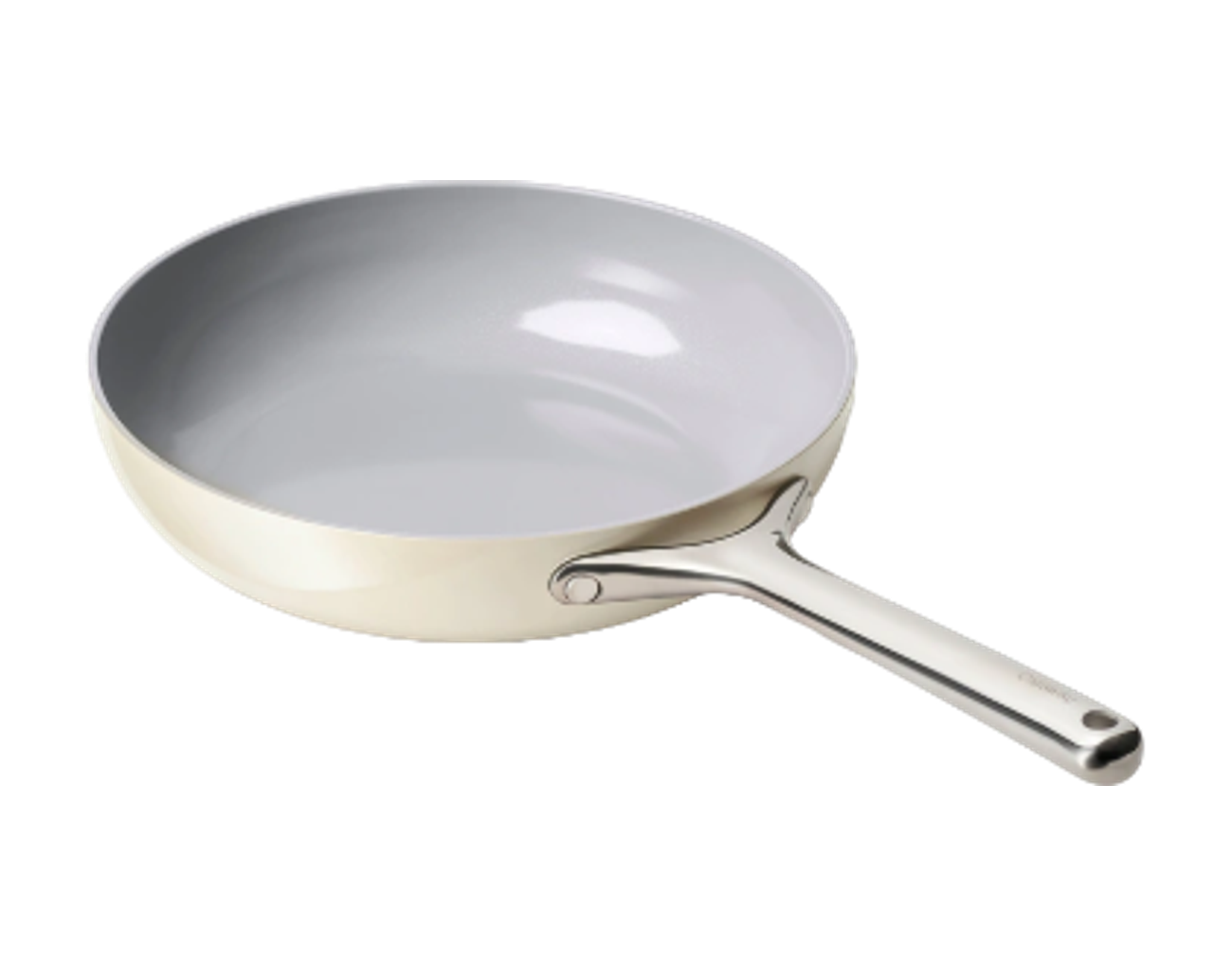
It looks better. No, really. My old PTFE pan was scratched and stained. The Caraway looks like a pan you’d display. Half of what makes us actually use the kitchen tools we own is whether we like seeing them.
What it’s actually like to cook with
Eggs slide. Pancakes flip clean. Fish doesn’t stick. The handle is balanced and stays cool on a gas burner. Heat distribution is even — better than my old nonstick, slightly behind a triply stainless.
The handle gets hot if you put it under a broiler for more than a few minutes. The cream interior shows oil staining over time, but it cleans off with Bar Keepers Friend.
It works on induction (magnetic stainless base) and goes in the oven up to 550°F. You can sear in it. You can finish a pasta sauce in it.
What you have to live with
Ceramic coatings degrade. This is the honest answer no brand wants to lead with. The internal abrasive layer wears down. The release performance drops. America’s Test Kitchen has documented this consistently — even premium ceramics show noticeable performance loss after 18–36 months of regular use. Caraway’s marketing implies longer; the user-review consensus puts it at 2–4 years.
You’re not buying a forever pan. You’re buying a 2–4 year pan that you’ll replace.
No dishwasher. The marketing says “dishwasher-safe.” The fine print says “we don’t recommend it.” Hand-wash unless you want to halve the lifespan.
No metal utensils. Wood or silicone only.
Where it sits relative to alternatives
The right way to build a cookware kit, in my opinion, is roughly:
- Cast iron (Lodge 10.25, ~$25) — sear, stove-to-oven, lifetime durability.
- One good stainless pan (All-Clad D3 10”, ~$140) — sauces, deglazing, the workhorse.
- One ceramic-coated nonstick (this) — eggs, fish, pancakes.
If you only have budget for two, drop the ceramic. If you only have budget for one, get the cast iron. If your daily breakfast is eggs and you hate the cast-iron seasoning ritual, the Caraway is the right tool to add.
Final verdict
Strong Buy. PTFE-free ceramic coating. Available in several colors.
The best ceramic-coated pan I’ve used and the right answer for someone replacing a worn-out PTFE pan who wants better aesthetics, PFAS-free construction, and is OK with replacing it every few years.
Who it's for
People replacing a worn-out PTFE nonstick who want something cleaner-looking and PFAS-free for eggs, fish, and delicate sautés.
Who should skip it
You sear at 600°F+, you wash everything in a dishwasher, or you're already comfortable with cast iron and stainless and don't really need a 'nonstick'.
In this review
- Caraway 10.5" Ceramic Fry PanPTFE-free ceramic coating. Available in several colors.Prices change often; use the retailer link for the current price.
Caraway 10.5" Ceramic Fry Pan
Strong Buy
The best-executed ceramic-coated nonstick pan I've used. Performs like a nonstick should, no PFAS, looks great. The only real catch is that no ceramic coating is forever — plan for a 2–4 year lifespan.
As an Amazon Associate, we may earn from qualifying purchases.
Frequently asked questions
Is ceramic-coated cookware actually safer than PTFE/Teflon?
How long will it last?
What about the lead/cadmium scandal a few years back?
Should I just buy cast iron instead?
Affiliate disclosure
Some links on this page may be affiliate links — we may earn a commission if you buy through them, at no extra cost to you. We only recommend products we think are worth considering. Verdicts are not influenced by commissions.