Therabody CryoTherm Palm review: smart cooling or $400 novelty?
Listed price $399.99 Recorded price snapshot. Confirm the final total at checkout.
View at Therabody →A genuinely interesting performance device with a narrow audience. The science is more specific than typical recovery marketing, but $399.99 is a lot to pay for a tool used during short rest windows.
Our verdict
A genuinely interesting performance device with a narrow audience. The science is more specific than typical recovery marketing, but $399.99 is a lot to pay for a tool used during short rest windows.
Why we landed on Good, But Not Essential
A genuinely interesting performance device with a narrow audience. The science is more specific than typical recovery marketing, but $399.99 is a lot to pay for a tool used during short rest windows.
Who we'd buy it for Competitive athletes, teams, and serious heat-training users who have a clear use for palm cooling between efforts.
Who we'd tell to skip it You train casually, already have effective low-cost cooling options, or expect one device to solve general soreness.
The part we will not talk past $399.99 is difficult to justify for casual exercisers.
Pros
- Cordless palm cooling is more convenient than ice, water, or frozen gel packs.
- Heat, cold, and contrast modes make it useful beyond one narrow scenario.
- Built-in stopwatch and calibrated temperature settings reduce setup friction.
- The product launched with controlled-study results rather than only lifestyle claims.
Cons
- $399.99 is difficult to justify for casual exercisers.
- The performance claims come from small, specific athlete studies and may not generalize.
- Battery life varies by modality, and the device weighs 1.14 pounds.
- It is a between-efforts tool, not a replacement for conditioning, hydration, or medical care.
We’d buy the CryoTherm Palm if you are a competitive athlete, a team, or a serious heat-training user with a clear use for palm cooling between efforts. We’d skip it if you train casually, already have effective low-cost cooling, or expect one device to solve general soreness. $399.99 is a lot to pay for a tool used during short rest windows, even with cold, heat, contrast, and a built-in stopwatch.
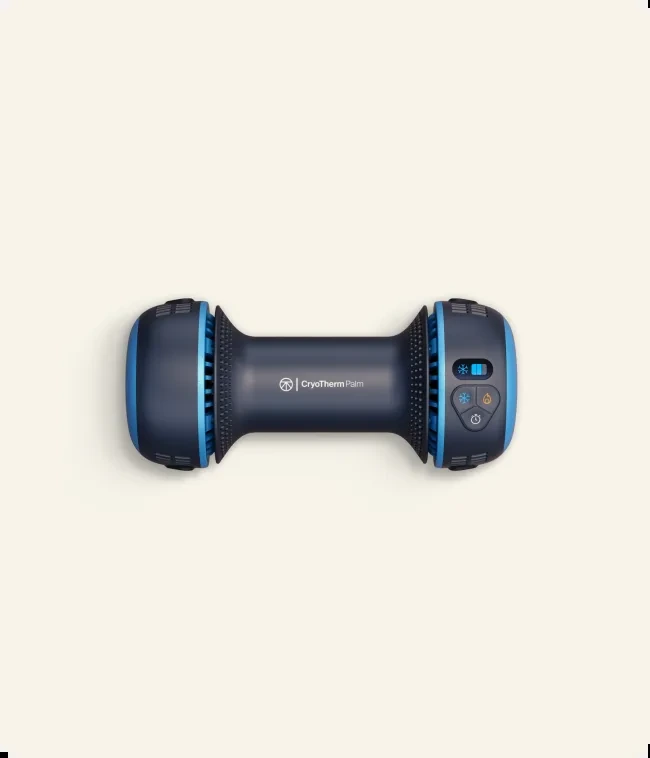
Therabody lists the device at 1.14 pounds, with cold settings from 46.4°F to 60.8°F, heat settings from 98.6°F to 109.4°F, USB-C charging, and up to 120 minutes of battery life depending on the mode.
The interesting part is the use case
CryoTherm Palm is not designed to sit in your living room while you watch TV. It is meant for the short gaps that already exist in training: between sets, during a timeout, at halftime, or between repeated sprint efforts.
That narrow timing is its strongest argument. A frozen pack is cheap, but it is inconvenient, inconsistent, and not always available when the session is underway. If a device can deliver a predictable temperature without ice, water, or a cooler, a coach or serious athlete may see the value quickly.
For everyone else, the use case gets harder to defend. Most people do not need a specialized performance tool between sets. They need better pacing, more consistent sleep, enough fluids, and a training plan that does not turn every session into a test of willpower.
The study results are promising—but specific
Therabody reports results from two controlled studies: one with Division I athletes doing resistance training and another with elite male soccer players doing repeated sprints. The reported outcomes include more final-set reps, more total work volume, lower perceived thermal strain, and better maintained sprint velocity.
Those results are worth paying attention to because they are more concrete than a generic recovery testimonial. They are also small studies with narrow protocols. A repeated-sprint result in 17–19-year-old elite soccer players is not the same as proving that a recreational runner, older adult, or desk worker will get the same benefit.
The right interpretation is “interesting performance tool with early evidence,” not “proven recovery cure.”
Heat and contrast make it more versatile
The cold mode is the headline feature, but the heat and contrast settings improve the value proposition. Warmth may be useful in cold-weather sessions, while contrast offers a way to switch sides without carrying multiple devices.
That versatility matters at this price. A single-purpose palm cooler would be a much harder sell. Still, versatility only counts if you will actually use the modes. More settings do not automatically mean more recovery.
Who should buy it?
Serious athletes, coaches, and performance teams are the natural audience. If a small improvement in repeat-effort quality matters to your work, competition, or training block, $399.99 may be a reasonable experiment—especially if the device replaces disposable ice logistics.
For casual gym users, I would wait. The price is too high to buy on curiosity alone, and the studies do not yet justify presenting it as a general wellness necessity.
Final verdict
CryoTherm Palm is more interesting than a lot of recovery gadgets because it has a defined mechanism, a defined use window, and published controlled studies. It is also exactly the kind of product that can be oversold when a narrow athlete study gets translated into universal wellness language.
At $399.99, this is a niche performance tool, not an everyday essential. I would be interested in testing it with repeated intervals, hot-weather training, and normal gym sessions before giving it a stronger buy recommendation.
Editorial take: Interesting, But Niche.
This review is based on Therabody’s published product information and study summaries, not hands-on testing. The direct product link is provided for readers who want to review the current listing; affiliate status is not currently verified.
Who it's for
Competitive athletes, teams, and serious heat-training users who have a clear use for palm cooling between efforts.
Who should skip it
You train casually, already have effective low-cost cooling options, or expect one device to solve general soreness.
In this review
- Therabody CryoTherm PalmConfirm the current Therabody listing, price, and return terms before you buy. We would not treat the heat, the cold, or day-to-day comfort as proven from the product page.Prices change often; use the retailer link for the current price.
Therabody CryoTherm Palm
Good, But Not Essential
A genuinely interesting performance device with a narrow audience. The science is more specific than typical recovery marketing, but $399.99 is a lot to pay for a tool used during short rest windows.
Frequently asked questions
What does the Therabody CryoTherm Palm do?
How much does CryoTherm Palm cost?
Does palm cooling improve performance?
Is CryoTherm Palm a replacement for an ice bath?
What should you still check before you buy?
Affiliate disclosure
Some links on this page may be affiliate links — we may earn a commission if you buy through them, at no extra cost to you. We only recommend products we think are worth considering. Verdicts are not influenced by commissions.
Health disclaimer
This content is for informational purposes only and is not medical advice. Talk to a qualified professional before starting new supplements, treatments, or major health changes.